 Email:
lisa@gelgoog.com
Email:
lisa@gelgoog.com Phone:
0086-155-1557-1373
Phone:
0086-155-1557-1373


 Language



Production Process of Britannia Biscuits For Industrial
The production process of britannia biscuits is a key area of study for many biscuit manufacturers when planning their business. These britannia biscuits have a consistent texture, uniform size, and enjoy a positive market reception.
Manufacturers who wish to produce britannia biscuits with a similar recipe structure, quality level, and market positioning can learn from and innovate upon the production process of these biscuits.
Britannia Biscuits Recipe
- In the production process of biscuits similar to Britannia biscuits, the raw materials are not complex, usually including flour, sugar, fat, water, dairy products, and functional additives.
- In industrial production, the protein content, ash content, and water absorption rate of the flour need to be kept within a controllable range. Otherwise, it will directly affect the dough's extensibility and the texture of the finished product.
- The ratio of sugar and fat determines the crispness and browning effect of the britannia biscuits, while moisture control is related to the stability of subsequent shaping and baking.
- In actual factories, this stage is usually ensured through: centralized raw material storage and batch management, automatic metering systems, and standardization of recipe parameters to ensure the consistency of each batch of dough.

Biscuit Dough Preparation
- Britannia biscuits are mostly hard biscuits, and their dough does not require strong gluten development, but rather emphasizes uniformity and plasticity.
- The function of the mixing equipment is not only to mix the ingredients but also to control the dough structure. Mixing time, speed, and ingredient addition order all affect the degree of gluten formation.
- Insufficient mixing can lead to dough cracking; excessive mixing can result in a hard texture in the finished product.
- Dedicated biscuit dough mixers can be used, with fixed mixing programs and repeatable process parameters, to ensure consistency in the britannia biscuit dough during long-term continuous operation.
Biscuit Forming
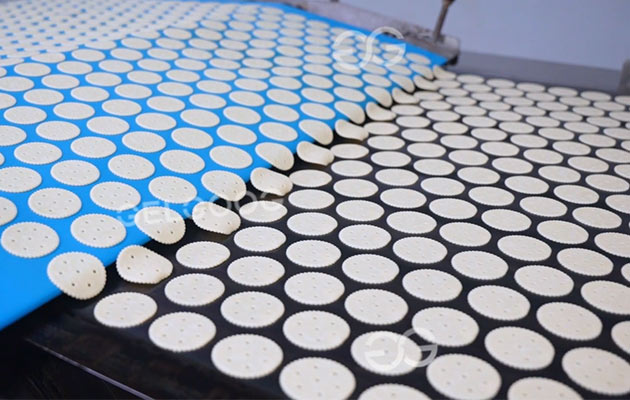
In the Production Process of Britannia Biscuits, the forming process directly determines the product's visual identity and market standardization.
- For this type of britannia biscuit, common industrial forming methods include:
- Roller cutting: suitable for flat biscuits with uniform thickness and clear patterns
- Molding: used for specific textures or brand identification requirements
- Laminating + cutting: used for products that emphasize textural layers
Forming equipment must not only ensure consistent shape but also seamlessly integrate with preceding and subsequent processes (feeding, conveying, baking) to prevent deformation or sticking.
Continuous Biscuit Baking System
Baking is a crucial step that determines the color, aroma, and moisture content of biscuits. Industrial production, similar to that of Britannia biscuits, almost exclusively uses multi-zone tunnel ovens.
- Front section: Dough expansion and structure setting
- Middle section: Internal moisture release and flavor development
- Rear section: Surface browning and texture stabilization
Through zoned temperature control and conveyor speed control, factories can achieve high consistency in britannia biscuit color and texture while maintaining production capacity.
Cooling, Sorting, and Packaging
After baking, the britannia biscuits are still at a high temperature. If packaged directly, they are highly susceptible to moisture absorption and breakage. Therefore, industrial production lines utilize forced cooling conveyor systems to cool the britannia biscuits to room temperature within a controlled timeframe.
After cooling, the britannia biscuits proceed to automatic sorting and counting, metal detection or quality inspection, and automatic packaging and sealing processes. The goal of this stage is to improve efficiency, reduce manual intervention, and ensure product stability during transportation and sales.