 Email:
lisa@gelgoog.com
Email:
lisa@gelgoog.com Phone:
0086-155-1557-1373
Phone:
0086-155-1557-1373


 Language



How to Choose the Right Biscuit Production Line Capacity
When building a biscuit factory or upgrading existing equipment, production line capacity is a crucial parameter to determine before purchasing. Many customers choose a production line based solely on the equipment's nominal kg/h rating.
But in actual projects, calculations must also factor in daily production targets, operating hours, product types, equipment utilization rates, and future expansion plans. Properly determining the biscuit production line capacity helps avoid issues such as insufficient output or oversized equipment configurations.
Start with Your Required Biscuits Daily Production
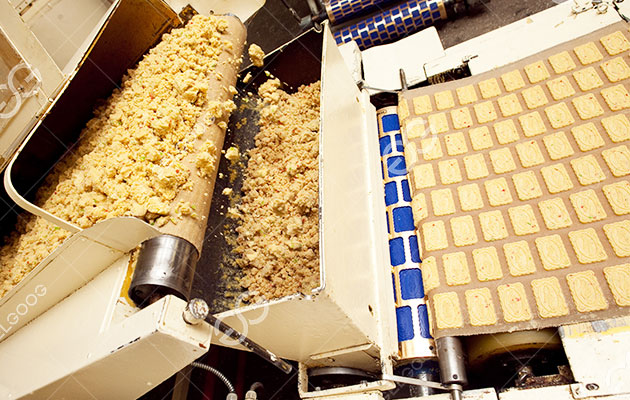
Before determining the biscuit production capacity, you must first clarify the planned daily production volume. For example, if a factory aims to produce 10 tons of biscuits per day and operates for 16 hours daily, the theoretical capacity required is:
10,000 kg ÷ 16 hours = 625 kg/h
This means the production line's theoretical capacity needs to be at least around 625 kg/h. However, actual production involves time for equipment startup, product changeovers, cleaning, maintenance, and brief stoppages. Therefore, it is not advisable to select equipment based solely on theoretical calculations. Usually, a capacity buffer should be included to ensure the line meets actual production demands.
If a customer plans to produce 20 tons per day with the same operating hours, the required theoretical capacity would be approximately 1,250 kg/h. In this way, you can first determine the appropriate biscuit production line capacity scope based on daily output, rather than simply comparing the rated capacities of different pieces of equipment.
Consider Biscuit Type and Working Schedule
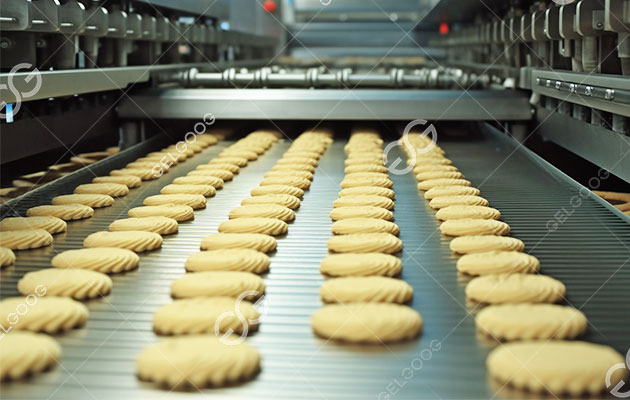
The type of biscuit also affects the production line configuration. Products such as hard biscuits, soft biscuits, and cookies differ in terms of ingredients, forming, baking, cooling, and packaging. Therefore, even if two factories have the same daily output, the required equipment configuration may differ.
Production shifts also need to be determined. Whether the factory operates for 8, 16, or 24 hours a day affects the required equipment capacity. For instance, while maintaining the same daily output, extending production time can lower the required hourly capacity; however, factors such as labor, energy, and equipment operating costs must be considered holistically.
Planning for Future Biscuit Production Capacity Growth
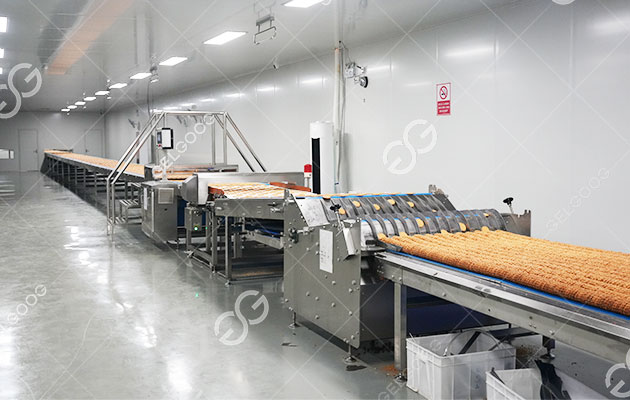
When selecting the biscuit production line capacity, future market demand should also be considered. If the factory currently plans to produce 10 tons per day but expects to increase this to 20 tons in the coming years, you could plan for a higher-capacity line from the start or reserve space for a second production line.
Additionally, the processing capacities of the baking, cooling, and packaging equipment must be balanced. If upstream capacity increases but cooling or packaging capabilities are insufficient, the entire production line will still be constrained. Therefore, production line capacity should not be determined by a single piece of equipment but rather planned based on the entire production process.
For new biscuit factories, it is recommended to first determine the target daily output and operating hours, then calculate the required biscuit production line capacity based on product type, equipment utilization, and future expansion needs, and finally finalize the specific configurations for forming, baking, cooling, and packaging.