 Email:
lisa@gelgoog.com
Email:
lisa@gelgoog.com Phone:
0086-155-1557-1373
Phone:
0086-155-1557-1373


 Language



Cookie Manufacturing Plant Setup for Producers
Before setting up a cookie manufacturing plant, new entrants to the industry or manufacturers looking to expand production should first determine the following:
- What type of cookies will you produce? (Butter cookies, chocolate chip cookies, sandwich cookies, etc.)
- Where is your target market?
- What is your planned daily production capacity?
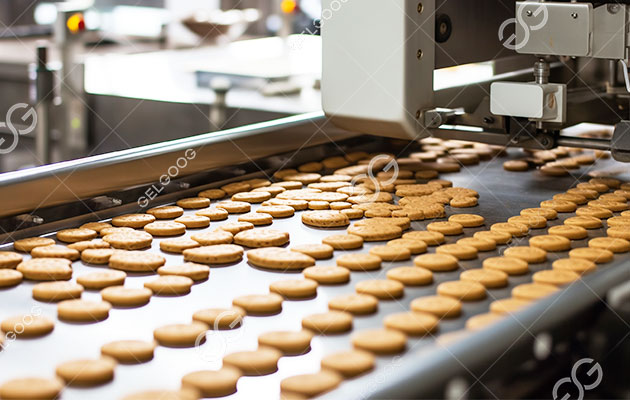
Different types of cookies require different forming methods. For example, wire cuts are suitable for soft cookies, rotary molders for shortbread cookies, and depositors for high-end fancy cookies. A unclear product structure will lead to increased costs for equipment adjustments later.
II. Planning Production Capacity and Production Line Structure
Reasonable production capacity planning is the core of a successful cookie manufacturing plant setup.
- Common industrial production capacity ranges:
- 200–300 kg/h (entry-level industrial line)
- 500–1000 kg/h (medium-scale)
- Above 1200 kg/h (large-scale continuous production)
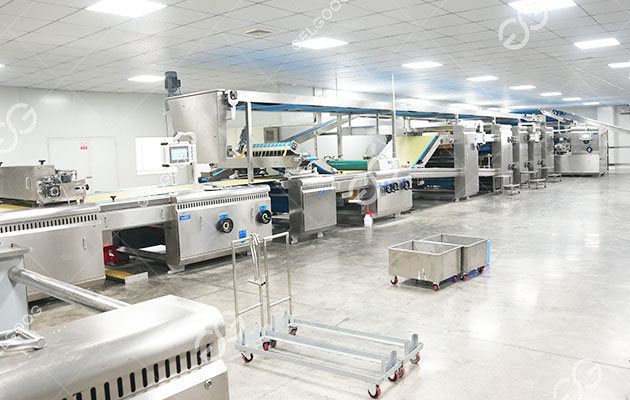
Standard cookie production processes typically include:
- Raw material metering and mixing
- Dough conveying
- Cookie forming system
- Tunnel oven baking
- Cooling and conveying
- Automatic packaging
Continuous production design reduces manual intervention and improves stability.
III. Key Cookie Processing Equipment Selection
During the equipment selection phase, the following core systems should be considered:
- Mixing System: Ensures uniform dough consistency and prevents oil-water separation.
- Forming Equipment: Select a rotary molder or wire cutter based on the product type.
- Tunnel Oven: Segmented temperature control, precise temperature adjustment, and uniform hot air circulation. Baking stability directly affects the product's color and texture.
- Cooling and Packaging System: A reasonable cooling length prevents moisture regain and improves packaging efficiency.
IV. Factory Layout and Flow Design
In a cookie manufacturing plant setup, the workshop layout determines long-term operational efficiency.
Recommendations:
- Separate raw material and finished product areas.
- One-way flow of materials.
- Reserve space for equipment maintenance.
- Consider future expansion interfaces.
A reasonable layout can reduce the risk of cross-contamination and improve the smoothness of cookie production.
V. Automation and Cost Control
For modern cookie manufacturers, the level of automation in their equipment directly impacts profit margins.
Advantages of high automation:
- * Automated ingredient dispensing systems reduce errors
- * PLC control improves stability
- * Energy optimization reduces long-term costs
From a long-term operational perspective, highly automated cookie production lines offer a greater return on investment.
After the cookie equipment is installed, we also need to perform the following: trial production adjustments, baking curve optimization, personnel training, and establishment of standard operating procedures. A well-executed commissioning phase ensures the production line quickly reaches a stable state.