 Email:
lisa@gelgoog.com
Email:
lisa@gelgoog.com Phone:
0086-155-1557-1373
Phone:
0086-155-1557-1373


 Language



How to Make Biscuits in Factory - Production Process
How to make biscuits in factory is a common question for many food manufacturers, as market demand for biscuits continues to grow and production gradually shifts towards industrial automation.
Compared to handmade production, factory production is not only more efficient but also offers advantages in terms of biscuit quality and food safety. By properly configuring biscuit production equipment, factories can consistently produce various types of biscuits to meet different market demands.
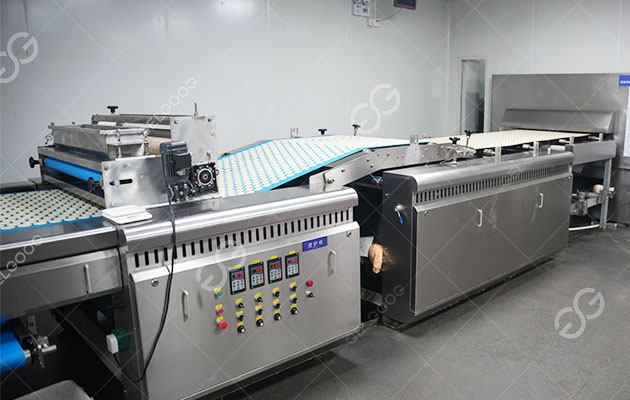
Overall Biscuit Production Process in Factory
In a factory, biscuit production typically follows a standardized process. From raw material processing and dough preparation to biscuit shaping, cooling, and packaging, each stage is closely interconnected.
The entire biscuit production process is characterized by continuity and stability to ensure consistency in the shape, texture, and baking results of the biscuits. Depending on the type of product (such as hard biscuits, soft biscuits, or cookies), the process details may vary, but the core process remains essentially the same.

How to Make Biscuits in Factory - The Main Steps
- The first step is ingredient preparation and dough mixing. Flour, sugar, oil, water, and other auxiliary ingredients are added to the dough mixer according to the recipe proportions. Low-speed and high-speed mixing ensures a uniform and stable dough structure, laying the foundation for subsequent shaping.
- The second step is biscuit dough shaping. The dough is processed into biscuit blanks of different shapes and thicknesses using methods such as roller cutting, roller printing, or wire cutting. The choice of shaping method directly affects the appearance and texture of the biscuits.
- The third step is baking. The biscuit blanks enter a tunnel oven, where the dehydration and browning process is completed within a set temperature range. A proper baking curve ensures that the biscuits are crispy inside and have an even color on the surface.
- The fourth step is cooling and sorting. After baking, the biscuits need to be cooled on a cooling conveyor line to prevent moisture absorption or deformation during packaging at high temperatures.
- Finally, packaging. The cooled biscuits enter the packaging process, where they are counted, arranged, and sealed for easy transportation and sale.
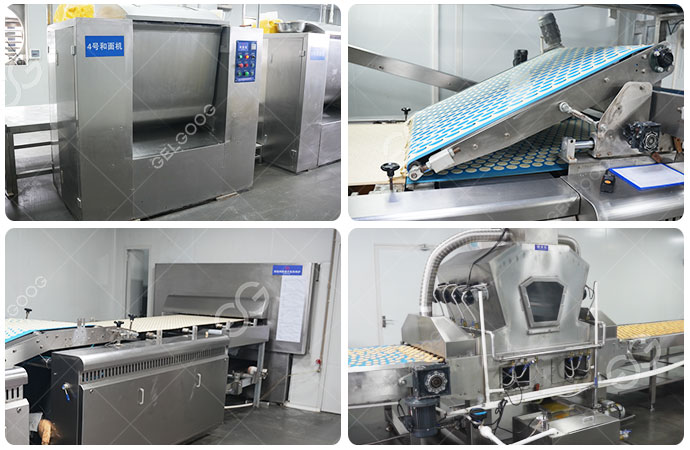
Core Equipment Required for Industrial Biscuit Production
A complete biscuit production line typically includes core equipment such as a dough mixer, biscuit forming machine, biscuit tunnel oven, cooling conveyor system, and packaging machine.
These machines are mostly made of food-grade stainless steel, operate stably, and are suitable for long-term continuous production. The equipment also features interchangeable molds and adjustable parameters, making it easy to switch between different biscuit products.
In addition to the equipment mentioned above, other common supporting equipment includes: oil spraying machines, sugar sprinkling machines, filling machines, etc. These machines can be combined according to different process requirements to help companies diversify their biscuit product range.